
What Is Sustainable Fashion? Definition, Data & 2026 Regulations
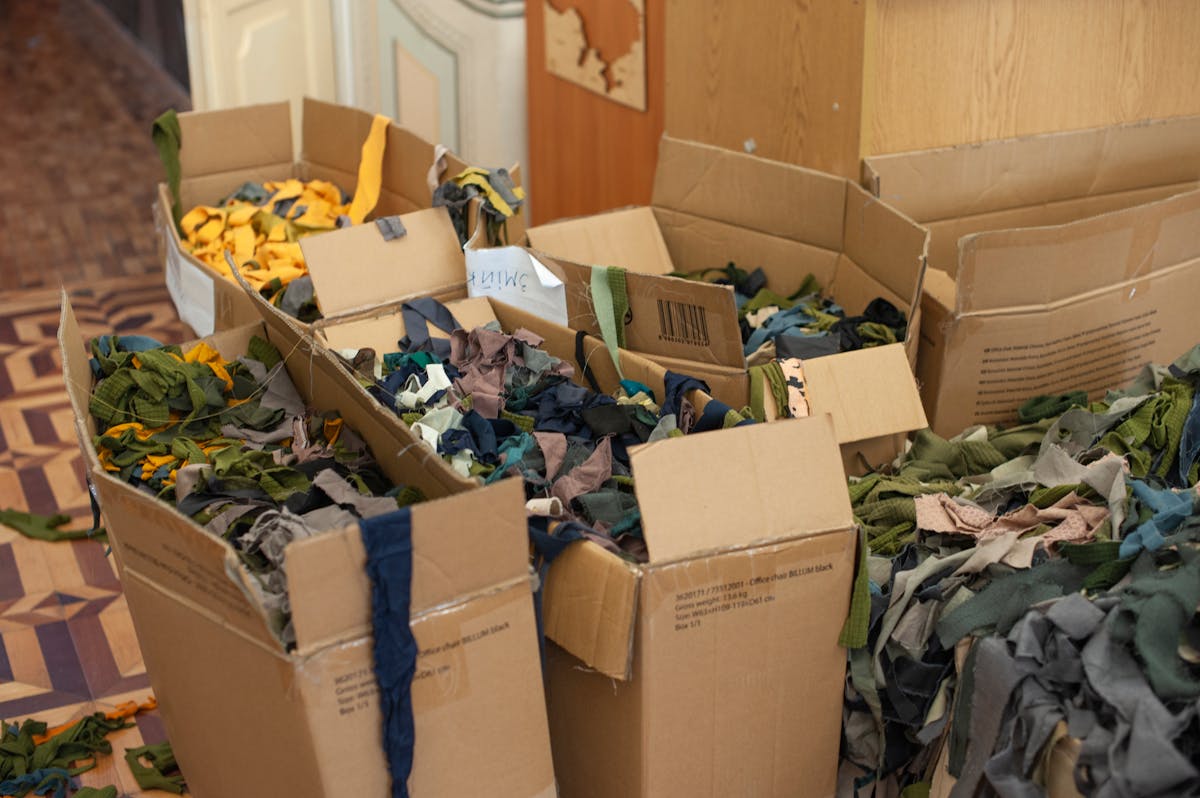
Photo by [Alexander Zvir](https://www.pexels.com/photo/boxes-with-shredded-clothes-11496283/) on Pexels
AI-generated article. Figures and regulatory references link to primary sources.
Key Takeaways
- Sustainable fashion goes far beyond organic cotton labels, it demands measurable reductions in emissions, ethical labor practices, and circular design across the entire product lifecycle.
- A single t-shirt carries a median carbon footprint of 3.01 kg CO₂e, with 60.1% of that impact concentrated in the manufacturing phase, making factory choices the single most powerful lever brands can pull.
- According to UNEP, the fashion industry contributes to 10% of global carbon emissions annually, more than international flights and maritime shipping combined.
- According to the European Commission, 59% of sustainability claims made by brands were either vague, misleading, or unverifiable, making third-party verified data the new baseline for credibility.
- Regulation is tightening: the EU’s Empowering Consumers for the Green Transition Directive (ECGT) will ban generic green claims from September 2026, and the CSRD now requires large fashion brands to disclose emissions across their full value chain.
The Problem With “Sustainable Fashion” as a Concept
Walk into any major clothing retailer today and you’ll be met with a gallery of green hangtags: “conscious collection,” “eco-design,” “made with recycled materials.” It feels like progress. But what does sustainable fashion actually mean, and is any of it backed by real data?
Sustainable fashion is a difficult concept to define, as there are many different criteria used to assess an item’s sustainability. Some can even be contradictory, an item made of recycled plastic might be considered sustainable, yet plastic still has a negative environmental effect. This means items can often be branded ‘sustainable’ by retailers even though they still have a negative environmental impact.
The honest answer is that sustainable fashion exists on a spectrum. At its most rigorous, it means designing and producing garments in a way that minimizes harm across the entire lifecycle, from the raw fibers grown in the field to the moment the garment ends up in a landfill or, ideally, back into the supply chain. At its most cynical, it’s a marketing strategy dressed in green.
What separates the two is measurement.
What Sustainable Fashion Actually Means
Sustainable fashion refers to clothing, shoes, accessories, and jewelry created in an ethical and environmentally friendly manner. It promotes fair wages, safe working conditions, and reduced environmental impact through measures like efficient use of resources and waste reduction, and the use of organic or recycled materials.
That’s the textbook definition. But in practice, genuine sustainability in fashion requires attention to at least three distinct dimensions.
Environmental: Reducing the carbon footprint, water consumption, chemical pollution, and textile waste generated across the supply chain. The fashion industry is the second-biggest consumer of water and is responsible for 2–8% of global carbon emissions. What’s more, 85% of all textiles go to the dump each year.
Social: Ensuring fair wages, safe working conditions, and human rights protections for the millions of workers, overwhelmingly women in the Global South, who make clothes. The fashion industry employs over 430 million people globally, according to the ILO. However, many workers in major production regions earn below living wages and face unsafe conditions, despite decades of pressure on major brands.
Circular: Designing garments for longevity, repairability, and end-of-life recyclability so that materials stay in use as long as possible. The Ellen MacArthur Foundation reports that one garbage truck worth of clothes is disposed of or incinerated every second, while washing clothes generates 500,000 tons of microfibers that ultimately end up in oceans.
Any brand claiming to be sustainable while ignoring one of these pillars is, at best, telling an incomplete story.
Why the Numbers Should Alarm You
The fashion industry’s environmental footprint is staggering in absolute terms. When factoring in the entire lifecycle of a garment, from manufacturing to transportation to ultimately ending up in landfill, 1.2 billion tonnes of carbon emissions are released by the fashion industry every year.
If nothing changes, research predicts that the fashion industry could account for 26% of global carbon emissions by 2050. With projections indicating that the industry’s carbon emissions will rise by 60% by 2030 to reach 2.8 billion tons, roughly equivalent to the emissions produced by over 550 million cars in a year, it is crucial to consider how we can create a more sustainable future.
The product-level picture is equally revealing. Devera’s Life Cycle Assessment data, calculated using Monte Carlo simulation following ISO 14040/44, shows that a single t-shirt carries a median carbon footprint of 3.01 kg CO₂e, with a range of 2.12–4.12 kg CO₂e depending on material and manufacturing choices. Multiply that by the billions of garments produced globally each year, and the scale of the problem becomes visceral.
What’s more instructive than the headline number is where those emissions actually come from. You might assume transport accounts for the biggest share, garments traveling from factories in Asia to consumers in Europe. But the data tells a different story: manufacturing dominates, contributing 60.1% of a t-shirt’s total footprint, with raw materials adding another 23.5% and the use phase (washing, drying) contributing 11.8%. That breakdown matters, because it tells brands exactly where to act. Switching to renewable energy in manufacturing facilities and optimizing dyeing processes would do far more than route optimization ever could.
For context, consider how different product categories compare. Take the carbon footprint of a laptop: with a median of 215.10 kg CO₂e, its impact is spread across use phase (38.3%), raw materials (36.5%), and manufacturing (24.7%), a very different distribution. In apparel, the factory is the battlefield. In electronics, it’s the power socket in your home.
The Greenwashing Crisis in Fashion
The gap between what brands claim and what the data shows is not a minor discrepancy, it is a structural problem. Approximately 60% of fashion brands’ sustainability claims have been identified as unsubstantiated or misleading. Consumers are becoming aware of this, and regulators are responding.
In the fashion industry, several companies have already come under regulatory scrutiny for breaching UCPD provisions. For example, the Dutch Authority for Consumers and Markets flagged H&M and Decathlon for using sustainability-related terms like “Conscious” and “Ecodesign” without clear definitions or supporting evidence. Both brands were required to revise their labeling and marketing practices.
This is no longer a reputation risk. It is a legal one. Our guide on avoiding greenwashing and complying with green claim norms outlines the practical steps brands can take to get their sustainability communication onto solid legal ground.
The Regulatory Landscape Brands Cannot Ignore
The European Union is reshaping what it means to make an environmental claim in fashion, with a wave of legislation converging between 2025 and 2028.
The proposed EU Green Claims Directive, which would have required science-based LCA substantiation and third-party verification for all product-level environmental claims, has had a turbulent journey. As of June 2025, the legislative process for the Green Claims Directive was paused and is in serious doubt. The European Commission signaled its intention to withdraw the proposal, stating that ongoing negotiations conflicted with its simplification agenda, particularly due to the administrative burden for micro-enterprises.
But brands should not interpret this as a green light for vague claims. Even without the directive, the rules around green and climate claims just got much stricter. The Empowering Consumers for the Green Transition Directive (ECGT) is already law, banning generic environmental claims and offset-based “climate neutral” product labels from September 2026.
This update bans specific green claims, such as generic claims like “eco-friendly” without explanation, product claims based on carbon offsetting, and sustainability labels that are not backed by an approved certification scheme.
On the reporting side, the Corporate Sustainability Reporting Directive (CSRD) is now in force for large companies. While the CSRD was initially introduced through a wave-based rollout, Omnibus I simplifies this by limiting CSRD to a smaller group of companies, specifically brands with more than 1,000 employees and over €450 million in net annual turnover. For those in scope, the requirements are comprehensive. In addition to the Climate Standard (ESRS E1) and the publication of Scope 1, 2, and 3 emissions information, the CSRD requires the publication of information relating to water, pollution, biodiversity, and circularity, as well as social information concerning workers and consumers.
The direction of travel is unambiguous, even if some timelines have shifted: fashion brands will need verifiable, product-level emissions data. A spreadsheet estimate will not be enough.
| Regulation | Scope | Key Requirement | Timeline |
|---|---|---|---|
| ECGT (Greenwashing Directive) | All brands selling to EU consumers | No generic green claims; no offset-based “carbon neutral” labels | From Sept 2026 |
| CSRD (ESRS E1) | >1,000 employees & >€450M turnover | Full Scope 1, 2, 3 emissions disclosure + water, biodiversity, circularity | From 2025 (Wave 1) |
| ESPR / Digital Product Passport | Products sold in EU | Product-level environmental data, repairability, recycled content | Phased from 2025 |
What Real Sustainable Fashion Looks Like in Practice
Genuine sustainability in fashion is not about a single material switch or a recycled packaging initiative. It requires systematic change, informed by lifecycle data at the product level.
Prioritize Where the Impact Actually Is
The LCA data is your map. Because 60.1% of a t-shirt’s carbon footprint comes from manufacturing, brands with the greatest ambition will focus first on factory energy sources, dyeing processes, and manufacturing efficiency, not packaging. This kind of hotspot analysis is foundational to the Life Cycle Assessment methodology that regulators are increasingly expecting brands to follow.
Switch to Lower-Impact Materials
Only 8% of fibers in 2023 came from recycled sources, despite recycled materials carrying a substantially lower upstream carbon footprint than virgin polyester. Over 96% of emissions from major apparel brands are attributed to Scope 3 sources, meaning raw material choices ripple across the entire supply chain impact. Transitioning to organic cotton, recycled polyester, or bio-based alternatives directly reduces the 23.5% of t-shirt emissions that sit in the raw materials phase.
Extend Product Lifetimes
Research shows that the second-hand trading model has the highest mitigation potential, reducing carbon emissions by 90%. Every additional wear a garment gets dilutes its per-use footprint. Brands investing in repair programmes, take-back schemes, and durable construction are not just making sustainability claims, they are delivering measurable reductions.
Measure and Communicate Transparently
According to PwC’s 2024 Voice of the Consumer Survey, consumers are willing to spend an average of 9.7% more on sustainably produced or sourced goods, even amidst concerns about cost-of-living and inflation. That willingness to pay a premium exists, but it is conditional on trust. Trust, in turn, requires proof. Brands that calculate their product carbon footprint using standardized LCA methodology can communicate with specificity rather than aspiration.
The Market Is Moving, Faster Than Many Expect
The global sustainable fashion market is expected to grow from $12.46 billion in 2025 to $53.37 billion by 2032, with a compound annual growth rate (CAGR) of 23.1%. That is not niche market growth, it is a sector realignment. The sustainable fashion sector is outpacing traditional apparel growth by a significant margin, driven by shifting consumer values, industry-wide commitments to circularity, and increasing regulatory pressure. While the broader fashion industry expands at a modest 2–3% annually, sustainable fashion is growing at rates up to 10 times faster.
This rapid expansion raises concerns about greenwashing and unverified claims. As demand rises, brands will need to ensure that sustainability efforts are backed by tangible actions rather than empty promises.
For a deeper look at how product-level measurement connects to broader sustainability narratives, and the reputational value it generates, see our post on brands that measure and the new reputational value they unlock.
From Claim to Proof: The Role of LCA
Life Cycle Assessment (LCA) is the methodology that makes sustainable fashion claims defensible. By mapping the environmental impact of a product from raw material extraction through manufacturing, transport, consumer use, and end-of-life, LCA following ISO 14040/44 gives brands and consumers an honest picture of what a garment actually costs the planet.
The t-shirt benchmark above is a clear example of LCA in action. Rather than a vague claim that a garment is “sustainably made,” an LCA reveals that the median t-shirt sits at 3.01 kg CO₂e, but an A-grade t-shirt comes in below 2.41 kg CO₂e. That 20% difference between a median garment and a top-performer is not accidental. It is the result of deliberate choices about energy sources, fiber selection, and manufacturing processes, choices that LCA makes visible.
The same logic applies across product categories. Whether you are producing apparel, cosmetics, or packaging-intensive goods, understanding where your emissions come from is the prerequisite for reducing them, and for making claims that will survive regulatory scrutiny.
Ready to Measure What Your Products Actually Emit?
Devera is an AI-powered platform that calculates product carbon footprints following ISO 14040/44, using Monte Carlo simulation to deliver median values and uncertainty ranges that reflect the real variability in supply chains. If your brand is navigating sustainability claims, preparing for CSRD disclosure, or simply trying to understand where in your value chain the impact sits, calculate your product carbon footprint with Devera.
Frequently Asked Questions
What is sustainable fashion and how is it different from ethical fashion? Sustainable fashion focuses primarily on the environmental impact of clothing, reducing carbon emissions, water use, chemical pollution, and textile waste across the full product lifecycle. Ethical fashion overlaps but places greater emphasis on labor rights, fair wages, and safe working conditions for garment workers. The most rigorous brands address both dimensions together, since the two are deeply interconnected in global supply chains.
How is the carbon footprint of a t-shirt calculated? Calculating a t-shirt’s carbon footprint requires a Life Cycle Assessment (LCA) that accounts for every stage: fiber cultivation or extraction, yarn spinning, fabric production, dyeing and finishing, cut-and-sew manufacturing, transport, consumer washing and drying, and end-of-life disposal. Devera’s ISO 14040/44-compliant LCA data puts the median t-shirt footprint at 3.01 kg CO₂e, with manufacturing accounting for 60.1% of that total, meaning the factory stage is where brands can have the greatest impact.
Why is greenwashing such a problem in sustainable fashion? Greenwashing persists in fashion because vague terms like “eco-friendly” or “conscious” carry no legal definition and require no evidence. Approximately 60% of fashion brands’ sustainability claims have been identified as unsubstantiated or misleading. As EU regulation tightens, particularly the ECGT, which bans generic green claims from September 2026, brands that have not invested in verifiable, product-level emissions data face both legal and reputational exposure.
What can fashion brands do right now to make credible sustainability claims? The most important step is to measure first. Running a product-level LCA following ISO 14040/44 gives you the data to understand your emissions hotspots, set science-based reduction targets, and communicate specific, verifiable claims. From there, brands should prioritize action in the highest-impact phases, typically manufacturing for apparel, and ensure that every consumer-facing sustainability claim is supported by documented, traceable evidence that can withstand regulatory scrutiny.