
Auditable Data & Full Traceability
Every number in your report has a verifiable source, a confidence level, and a documented methodology. No black boxes.
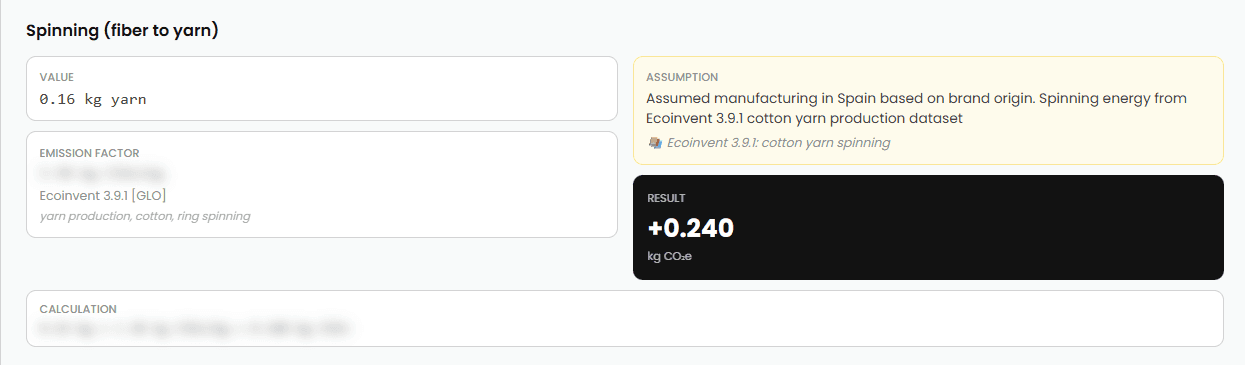
Every data point connected to its origin
An auditor can verify every value in your report directly against the original database.
Exact Source & Activity Name
Every emission factor shows the exact database activity (e.g., "market for fibre, cotton, organic"), not generic labels. An auditor can verify each value directly.
Confidence Level Per Data Point
Each value includes its confidence level: HIGH (exact DB match), MEDIUM (regional or fuzzy), LOW (category), ESTIMATED (proxy). No grey areas.
Documented Source Cascade
The report shows which database provided each data point: Ecoinvent 3.12, AGRIBALYSE 3.2, Base IMPACTS 3.0, DEFRA 2025 or INCI Database. If it's a proxy, it says so explicitly.
Geographic Data Location
Each EF includes its geographic coverage (ES, RER, GLO). The system prioritizes local data over global — and the report documents which level was used.
Anatomy of a traceable data point
"Organic cotton"
Full ISO 14040/44 documentation
This is what an auditor sees in every Devera report — generated automatically, not filled in by hand.
Goal of the Study
To quantify the carbon footprint (kg CO₂e) of Minimalism Brand Organic Cotton T-Shirt across its full life cycle, from raw material extraction to end-of-life disposal, following ISO 14040/44 methodology.
Functional Unit
One unit of Minimalism Brand Organic Cotton T-Shirt (0.215 kg), including primary packaging, delivered to consumer and disposed of at end of life.
System Boundaries & Exclusions
Included: Raw materials, packaging, manufacturing, transport to consumer, use phase, end-of-life (cut-off method).
Excluded: Capital goods, infrastructure, employee commuting, retail operations.
Data Quality Assessment
Screening level: based on secondary data from verified databases (Ecoinvent 3.12, AGRIBALYSE 3.2, Base IMPACTS 3.0, DEFRA 2025, INCI; IPCC AR6 characterisation). For higher accuracy, upload primary data.
Sensitivity Analysis
Key variables with highest impact: MANUFACTURING (69% of total). A ±20% variation in the main contributor would result in approximately ±14% change in total footprint. Electricity grid factors and transport distances are secondary sensitivity parameters.
Extra Audit
Verify references traceability and data quality (Pedigree Matrix).
Real excerpt from a Devera report. Automatically generated for every analysis.
Automated validation at every step
The system catches and corrects errors before they reach your report. It doesn't rely on AI — these are deterministic rules based on science.
Anti-Outlier Validation
Every emission factor is validated against expected ranges per material category (plastic: 0.5–15, metal: 0.3–50, textile: 0.3–60 kg CO2e/kg). Extreme outliers (>5x max range) are automatically rejected and the system queries the next source.
Multi-Material Weight Allocation
For complex products (chair with steel + wood + foam), each manufacturing process is applied only to the correct material weight. Milling applies to metal, not to the entire product. Each allocation is documented in the report.
Intelligent Name Resolution
"Organic cotton velour" is simplified to "organic cotton" and mapped to the correct Ecoinvent activity. Without this step, the material would fall to a generic proxy. The report shows both the original and resolved name.
Inappropriate Data Blocklist
Some Ecoinvent data is technically correct but inappropriate for finished products. Example: raw wool (37.6 kg CO2e/kg) vs processed wool (18.2). The system blocks these sources and uses DEFRA with values for actual textile products.
Ready for audit and compliance
Export for Auditors
Excel with raw data, sources, and references. PDF with documented methodology. Everything an auditor needs.
Version History
Every report change is tracked: what was modified, when, and why. Full revision trail.
ISO 14040/44
Methodology, system boundaries, and assumptions documented following the international LCA standard.
Ready to measure your impact?
Get your Product Carbon Footprint in minutes, not months.