
Full Life Cycle Assessment, automated
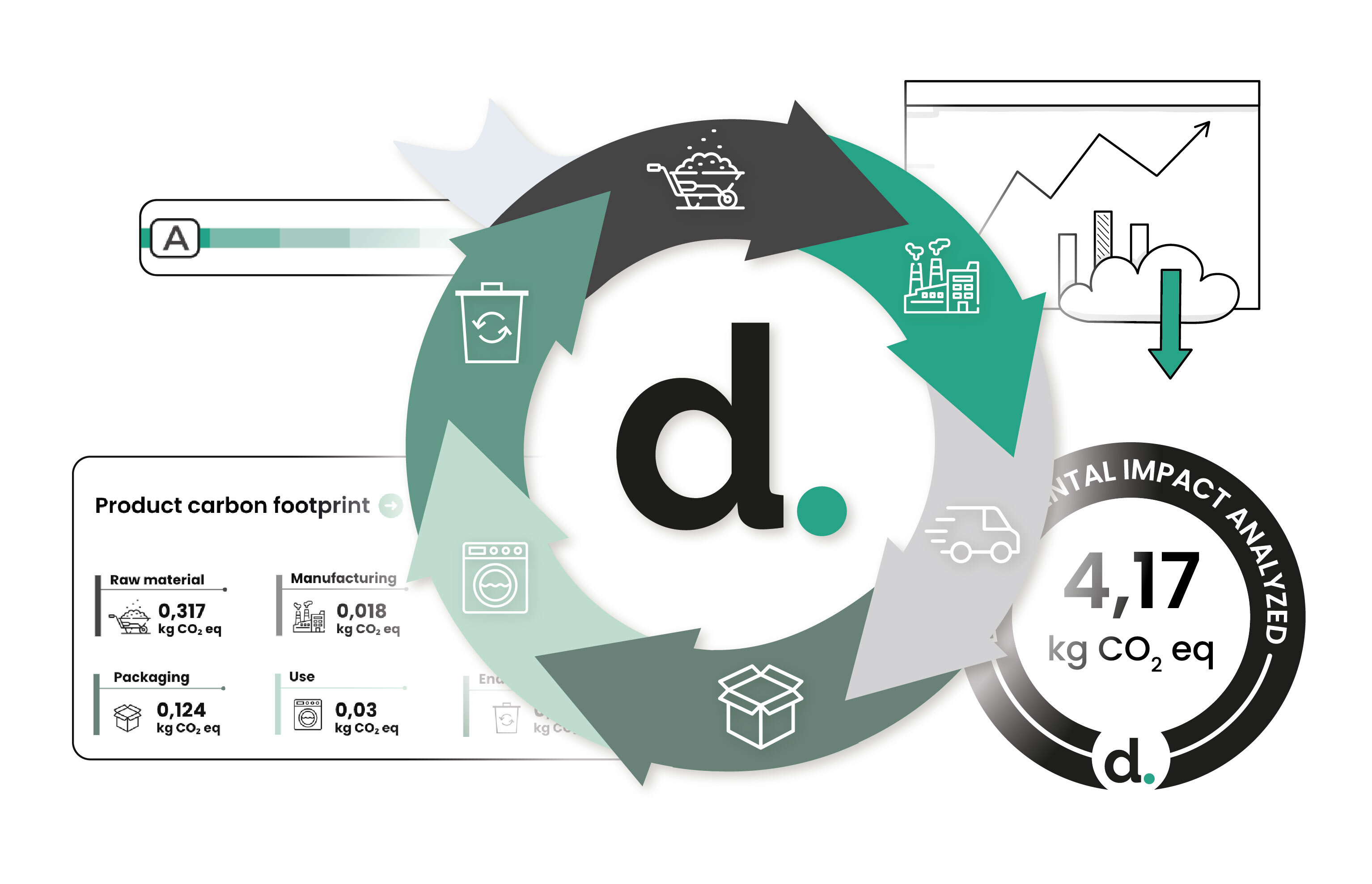
The 16 EF v3.1 impact categories, carbon footprint included. ISO 14040/44 compliant, SGS-validated, with every emission factor traceable to its source.
Powering the world's best product-based companies

















16 impact categories, one methodology
A carbon footprint measures climate change. Full LCA adds the other 15 categories to show your product's complete environmental impact.
The three toxicity categories and water use are flagged "care": toxicity carries higher model uncertainty and water use applies the AWARE factor as a global average, not regionalised. Coverage is declared per category; components with no characterised data are reported as n/a, never guessed.
Full LCA is in beta. Your SGS-validated carbon footprint is unaffected.
From carbon footprint to the full LCA
Automated. Accurate. Actionable.
Share your product
Paste a product URL or upload documents. Our AI extracts materials, processes, packaging, and transport.
Get your full LCA
In minutes you get an ISO 14040/44 report across the 16 EF v3.1 impact categories, with every emission factor traceable to its source.
Explore and simulate
Find the hotspots in each impact category, test material and packaging alternatives, and compare scenarios instantly.
Share and export
Export to PDF, Excel, or CSV, and share via public link, widget, or badge.
Meet standards. Prove your impact.
ISO 14040/44 Compliant
Full auditability with documented emission factors, assumptions, and traceable data sources.
EF v3.1 (PEF) method
The 16 categories of the European Commission's Product Environmental Footprint, computed with Ecoinvent 3.12.
SGS-validated
Our LCA methodology has been independently validated by SGS to ISO 14040:2006 and ISO 14044:2006.
Read our full methodology
Databases, emission factor cascade, the 16 EF v3.1 categories, and system boundaries, in detail.
LCA and carbon footprint: how they fit
Full LCA (16 categories)
The complete environmental profile: water, land, eutrophication, resources and more, on the same basis as your carbon footprint. It avoids burden shifting between categories and supports multi-criteria ecodesign.
Product Carbon Footprint (PCF)
One category: climate change, in kg CO₂e. A simpler, lower-cost option when you only need the climate metric, for example for Scope 3 reporting. You can upgrade it to Full LCA anytime.
FAQs about Life Cycle Assessment
What is a Life Cycle Assessment (LCA)?
A Life Cycle Assessment (LCA) quantifies a product's environmental impacts across its entire life cycle, from raw material extraction to end of life. Unlike a carbon footprint, which measures only climate change, a full LCA covers multiple impact categories such as water use, land use, eutrophication, and resource use. It follows the ISO 14040 and ISO 14044 standards.
How is Full LCA different from a Product Carbon Footprint (PCF)?
A Product Carbon Footprint (PCF) measures a single category: climate change, in kg CO₂e. Full LCA is the complete analysis: it adds the other 15 EF v3.1 impact categories on the same basis. In Devera, Full LCA is the complete analysis and PCF is a simpler, lower-cost option that covers carbon only. The carbon figure is identical in both.
Which impact categories does Devera calculate?
The 16 impact categories of the EF v3.1 method: climate change, ozone depletion, human toxicity (cancer and non-cancer), particulate matter, ionising radiation, photochemical ozone formation, acidification, eutrophication (terrestrial, freshwater, and marine), freshwater ecotoxicity, land use, water use, and resource use (fossils and minerals/metals).
What impact assessment method do you use?
We use Environmental Footprint (EF) v3.1, the method behind the European Commission's Product Environmental Footprint (PEF). Characterisation factors and impact vectors are computed with Ecoinvent 3.12 via Brightway, never invented. The carbon footprint methodology is independently validated by SGS to ISO 14040:2006 and ISO 14044:2006.
How do I get a Full LCA and how long does it take?
Run a Full LCA directly: it is the complete 8-credit analysis covering all 16 categories, ready in minutes. If you only need carbon, choose the simpler PCF (5 credits) and add the other 15 categories whenever you want (+3 credits). We show you the estimated coverage for your product before any charge.
What does coverage mean and why do some categories show "n/a"?
Coverage is the share of your product's impact backed by real data in each category. When a component has no characterised data for a category, it is reported as "n/a" rather than guessing a value. We show coverage per category transparently, in line with the ISO 14044 treatment of missing data.
Why are toxicity and water use flagged "use with care"?
The three toxicity categories (human toxicity cancer and non-cancer, and freshwater ecotoxicity) carry higher model uncertainty. Water use is computed with the AWARE factor as a global average, not regionalised, so two identical products in an arid or humid region get the same value. We flag these so they are read with care, exactly as in the platform.
What is a Full LCA for?
For ecodesign and prioritisation: seeing where a product's real impact sits beyond carbon, avoiding burden shifting between categories, comparing materials and suppliers on a multi-criteria basis, and supporting substantiated environmental claims under the EU Green Claims Directive. It is a screening-level LCA and does not replace a critically reviewed EPD.
What our users say
Devera makes product carbon footprinting accessible to teams without deep LCA expertise. The automated data extraction alone saves us hours per project.
We needed a reliable way to measure our product impact without hiring an external consultancy. Devera delivered exactly that — fast, auditable, and ISO-compliant.
What used to take our team months of back-and-forth with consultants now takes minutes. The benchmark feature helps us communicate our progress to stakeholders.
The level of traceability in Devera's reports is impressive. Every emission factor is documented and sourced — exactly what we need for our Green Claims compliance.
The what-if simulator is a game changer. We can test different materials and packaging options and see the impact instantly. Helps us make better design decisions.
Devera makes product carbon footprinting accessible to teams without deep LCA expertise. The automated data extraction alone saves us hours per project.
We needed a reliable way to measure our product impact without hiring an external consultancy. Devera delivered exactly that — fast, auditable, and ISO-compliant.
What used to take our team months of back-and-forth with consultants now takes minutes. The benchmark feature helps us communicate our progress to stakeholders.
The level of traceability in Devera's reports is impressive. Every emission factor is documented and sourced — exactly what we need for our Green Claims compliance.
The what-if simulator is a game changer. We can test different materials and packaging options and see the impact instantly. Helps us make better design decisions.
Ready to measure your impact?
Get your Product Carbon Footprint in minutes, not months.