
LCA software that works at the speed of your business.
SimaPro has been the industry reference for three decades. Devera is the modern alternative for teams who need credible, ISO-compliant LCAs without hiring a consultant or waiting weeks per product.
ISO 14040/44 and 14067 methodology. GDPR-ready.
















Three things to know before you compare
You know your product. That is enough.
SimaPro expects you to be an LCA practitioner who can build a unit process tree. Devera expects you to know your product. The AI handles the methodology so you do not have to.
Minutes, not weeks.
A product LCA in SimaPro is a multi-day expert project. In Devera it is a few minutes of review. Same databases, same ISO standards, completely different effort.
Pricing published. No sales call.
SimaPro requires a conversation with sales to see pricing. Devera publishes plans starting at 49 euros. You can run your first LCA before speaking to anyone.
Why traditional LCA tools fail at product scale
If you have ever tried to run life cycle assessments across an entire product catalog, you have met the wall. A consumer brand with 60 SKUs cannot afford a 40-hour consultant engagement per product. A startup launching a new line cannot pause six months to train an in-house LCA team. A sustainability manager at a food or cosmetics company does not want to learn matrix-based inventory modeling. They want a defensible carbon footprint for product 24 so they can respond to a retailer questionnaire or put a number on a label.
SimaPro is an excellent tool if you have the time, budget, and expertise. It is powerful, deeply customizable, and trusted by LCA consultancies worldwide. It is also desktop-first, expert-only, and priced for enterprises that can dedicate full-time practitioners to the work. For a small team running dozens of product LCAs a quarter, the model does not scale.
Devera was built around one question. Can AI handle the parts of an LCA that require methodology knowledge, while the user only provides product knowledge? The answer turned out to be yes. The AI reads product data, maps it to Ecoinvent activities, fills data gaps with validated proxies, and produces a full cradle-to-grave analysis. The user reviews, adjusts if needed, and exports. The methodology, standards, and emission factors are the same. The experience is completely different.
Side-by-side comparison
| SimaPro | Devera | |
|---|---|---|
| Primary user | LCA expert, consultant | Product teams, sustainability managers, consultants |
| Learning curve | Weeks of training. Certification offered. | None. Drop a product URL or a PDF. |
| Time per product LCA | Days to weeks of expert work | Minutes |
| Modeling approach | Manual unit process construction | AI-driven automated inventory |
| Gap filling | Manual proxy selection by the user | Automatic, validated cascade |
| Deployment | Desktop (Windows) and Cloud | Web, any browser |
| Databases | Selected and licensed separately | Ecoinvent 3.12, AGRIBALYSE, Base IMPACTS, DEFRA, INCI. Included. |
| Standards | ISO 14040/44, 14067 | ISO 14040/44 (validated by SGS), 14067 |
| Published pricing | No. Contact sales. | Yes. From 49 euros. |
| Self-service trial | Not available | Yes. First LCA free. |
| API access | Limited | REST API with keys |
| Export formats | PDF, Excel, EcoSpold | PDF, Excel, CSV, shareable URL |
Time and workflow
In SimaPro, a typical product LCA project looks like this. The practitioner opens a new project, defines functional unit and system boundaries, builds a process tree manually by selecting activities from Ecoinvent, enters quantities for each input, handles allocation decisions for co-products, runs the calculation, reviews hotspots, iterates, and finally exports results. For a single product this is a multi-day effort. For a portfolio, it is a multi-month program.
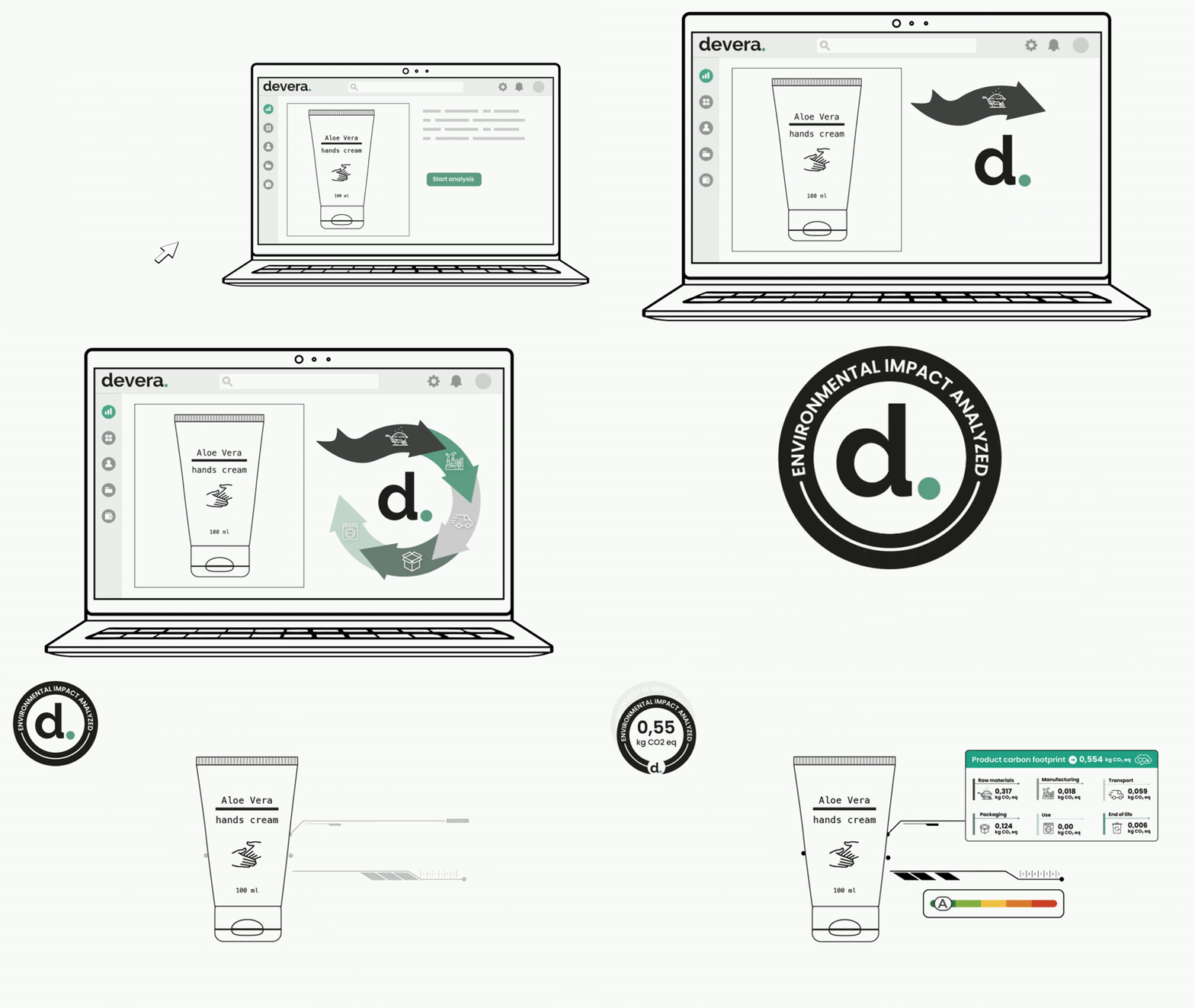
In Devera, the practitioner opens the app, pastes a product URL or uploads a PDF specification, reviews the AI-generated inventory, and exports. The AI handles activity mapping, gap filling, and calculation. The result is an ISO 14067 compliant carbon footprint that would have taken a week of expert work.
This difference changes what sustainability teams can actually do. When LCA takes minutes instead of weeks, you can run simulations, compare packaging options, respond to retailer requests in real time, and put impact data on every product page.
Data, databases, and methodology
Both tools use the same underlying data. Ecoinvent is the gold standard for LCA databases globally, and both Devera and SimaPro integrate it. The difference is how it is accessed and licensed.
SimaPro does not bundle Ecoinvent. You license it separately on top of the SimaPro subscription, and the terms depend on your user scope and tier. Managing two contracts, renewing them, and checking which version is active is part of the operational overhead.
Devera includes Ecoinvent 3.12 in every plan. It also includes AGRIBALYSE 3.2 for food products, Base IMPACTS 3.0 for textiles, leather and finished consumer products, DEFRA for UK-specific emission factors, and the INCI database for cosmetic ingredients. There are no separate data licenses to manage.
On methodology, both tools are ISO compliant. Devera uses IPCC 2021 100-year GWP as the default impact assessment method, which is the standard for product carbon footprint declarations under ISO 14067. Every emission factor used in a Devera LCA is traceable to its source and auditable.
Pricing and total cost of ownership
SimaPro does not publish pricing. The real total cost depends on the license tier, the number of users, the database licensing on top, training, and the cost of the expert who will actually operate the tool. For a small product team, these variables add up quickly and scale with each additional user.
Devera publishes everything on the website. The Seed plan at 49 euros includes 10 credits, enough for two full LCAs. The Coral plan at 149 euros includes 50 credits. The Ocean plan at 199 euros includes 120 credits, enough for 24 product LCAs or a mix of analyses, simulations, and impact scores.
The two economic models target different buyers. SimaPro absorbs the per-LCA cost into a consulting engagement or an in-house practitioner salary. Devera makes product-level LCAs economically viable for small and mid-sized teams without either of those.
Who each tool is for
SimaPro is the right choice if you are an LCA consultancy with dedicated experts, you need to model complex industrial systems with custom unit processes, you publish academic research that requires specific impact methods, or you work in sectors with highly specialized databases.
Devera is the right choice if you are a product team at a consumer brand, you need to run LCAs across many products, you want published pricing and self-service access, you prefer web over desktop, or you do not want to hire an LCA consultant every time you change packaging.
These are different tools for different jobs. SimaPro is a specialist workbench. Devera is a product team tool that also works well for consultants who want to cover more clients in less time.
What our users say
Devera makes product carbon footprinting accessible to teams without deep LCA expertise. The automated data extraction alone saves us hours per project.
We needed a reliable way to measure our product impact without hiring an external consultancy. Devera delivered exactly that — fast, auditable, and ISO-compliant.
What used to take our team months of back-and-forth with consultants now takes minutes. The benchmark feature helps us communicate our progress to stakeholders.
The level of traceability in Devera's reports is impressive. Every emission factor is documented and sourced — exactly what we need for our Green Claims compliance.
The what-if simulator is a game changer. We can test different materials and packaging options and see the impact instantly. Helps us make better design decisions.
Devera makes product carbon footprinting accessible to teams without deep LCA expertise. The automated data extraction alone saves us hours per project.
We needed a reliable way to measure our product impact without hiring an external consultancy. Devera delivered exactly that — fast, auditable, and ISO-compliant.
What used to take our team months of back-and-forth with consultants now takes minutes. The benchmark feature helps us communicate our progress to stakeholders.
The level of traceability in Devera's reports is impressive. Every emission factor is documented and sourced — exactly what we need for our Green Claims compliance.
The what-if simulator is a game changer. We can test different materials and packaging options and see the impact instantly. Helps us make better design decisions.
How to move from SimaPro to Devera
Most teams do not need a hard migration. They add Devera for the high-volume work and keep SimaPro for the cases where it genuinely earns its keep.
- 1
Validate the methodology
Run one product in Devera that you have already modeled in SimaPro. Compare the results. Because both tools use Ecoinvent 3.12, the numbers should match within a few percentage points. This validates that Devera gives the same scientific answer, just faster.
- 2
Cover the portfolio
Identify the products you want to cover. Most teams start with the top 20 by revenue or strategic importance. Run them in Devera, export the reports, and use them for retailer questionnaires, product pages, or internal decision making.
- 3
Keep SimaPro where it adds value
Deep academic work, complex industrial systems, custom methodology development. Let Devera handle the volume and keep SimaPro for the cases where the expert workbench genuinely matters.
Frequently asked questions
Is Devera as accurate as SimaPro?
Both tools use Ecoinvent 3.12 and follow ISO 14040/44 and ISO 14067. The calculated numbers are the same when the inventory is the same. Devera automates the inventory building. That is the difference. Not accuracy, but who builds the inventory.
Can I get third-party verification with Devera results?
Yes. Every LCA exports with full traceability. Every emission factor is sourced, every assumption documented. Third-party verifiers have successfully verified Devera-produced LCAs.
What happens if the AI gets something wrong?
You review and edit every inventory before finalizing. The AI proposes. You decide. If a material is misidentified or a process is inaccurate, you change it. The AI chat helps you iterate without leaving the report.
Can I export my Devera results to SimaPro format?
You can export the full inventory to Excel, which can be used as a reference when building the same model in SimaPro. Direct EcoSpold export is on the roadmap.
Does Devera handle building or construction LCAs?
No. Devera focuses on consumer and industrial products. For buildings and infrastructure, other tools are better suited.
What languages are supported for reports?
Reports export in English, Spanish, German, and French. The app interface is in English.
Can I use my existing Ecoinvent license with Devera?
You do not need to. Ecoinvent 3.12 is included in every Devera plan at no extra cost.
Compare Devera to other LCA tools
Ready to measure your impact?
Get your Product Carbon Footprint in minutes, not months.