
The software is free. The LCAs are not.
openLCA is a widely respected open source tool. Running actual LCAs in it still requires paid databases, LCA expertise, and hours of manual modeling per product. Devera includes everything and uses AI to do the modeling.
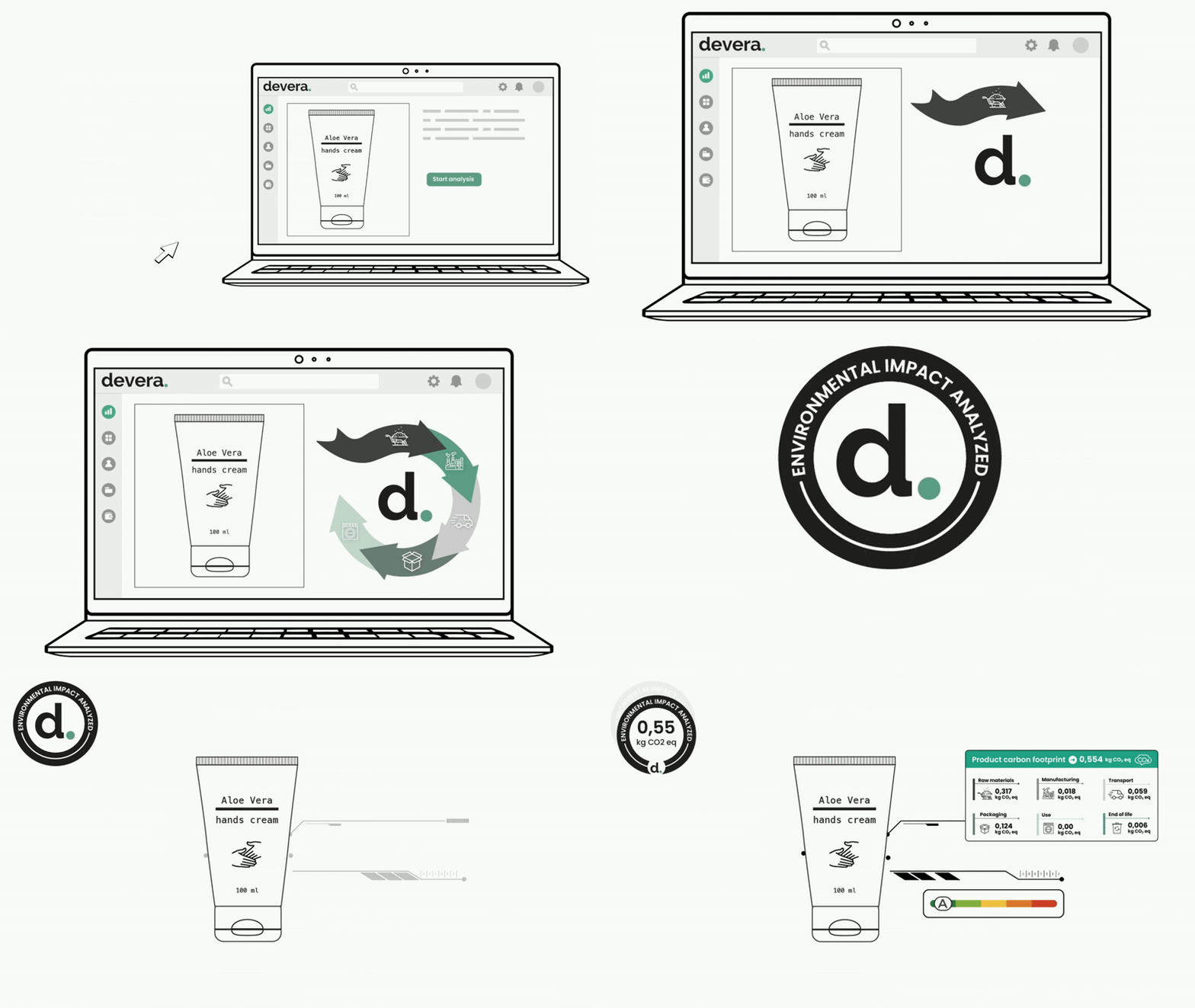
ISO 14040/44 and 14067 methodology. GDPR-ready.














Three things to know before you compare
Everything included, nothing extra to license.
openLCA is free but you still need Ecoinvent separately and an expert to operate it. Devera bundles the databases and automates the modeling, so the real cost for a product team is often lower.
No LCA training required.
openLCA assumes you already know LCA methodology. Devera assumes you know your product. The AI builds the inventory. You review and export.
The AI does the modeling.
openLCA has no automation, no gap filling, no intelligent mapping. Every inventory is built by hand. Devera proposes an inventory automatically and you validate it.
The total cost of a free LCA tool
The appeal of openLCA is obvious. Free software removes the budget barrier, which matters a lot in universities, in PhD research, and in any context where the institution already employs a dedicated LCA practitioner. For those users, openLCA is an excellent choice.
For a product company, the math is different. The software itself costs nothing, but a serious LCA requires Ecoinvent or an equivalent database, which is licensed separately from the software. Then you need an expert, either on payroll or on contract, who knows how to build a unit process tree, handle allocation, select impact methods, and produce an audit-ready output. A single well-built product LCA typically takes 20 to 40 hours of expert time.
Put together, the real cost of running LCAs in openLCA for a product company with a small portfolio often exceeds the cost of a full subscription to a modern SaaS tool. And you still have to redo the manual work every time a packaging changes or a supplier is swapped.
Devera was built as the alternative for that specific audience. Product teams who want credible LCAs, who do not have an LCA expert on staff, and who want to focus on product decisions rather than learning matrix-based inventory modeling.
Side-by-side comparison
| openLCA | Devera | |
|---|---|---|
| Software cost | Free | From 49 euros |
| Ecoinvent database | Separate license | Included in every plan |
| AGRIBALYSE, Base IMPACTS, DEFRA, INCI | Not bundled | Included |
| LCA expertise required | Yes. Expert or consultant. | No. Self-service. |
| AI and gap filling | Not available | Automatic, validated cascade |
| Setup time | Hours to days | Minutes |
| Time per product LCA | Days of manual expert work | Minutes of review |
| Deployment | Desktop | Web (SaaS) |
| Collaboration | LCA Collaboration Server (separate) | Built-in team sharing |
| Standards | ISO 14040/44, 14067 | ISO 14040/44 (validated by SGS), 14067 |
| Published pricing | N/A (database and expert costs vary) | Yes. From 49 euros. |
| Self-service signup | Not applicable | Yes. First LCA free. |
Expertise and workflow
openLCA is described as user-friendly and intuitive, and relative to other expert LCA software that claim is fair. In absolute terms, it still requires genuine LCA expertise. You need to understand unit processes, reference flows, allocation methods, impact assessment selection, and how to map real product data to abstract database activities. The interface is an expert interface because the job it helps you do is an expert job.
Devera takes the opposite approach. The user provides product data, either by pasting a URL, uploading a PDF specification, or filling a short form. The AI handles the mapping to Ecoinvent activities, the gap filling for missing data, and the calculation. The user then reviews the result in a readable dashboard, adjusts anything that looks off, and exports. No unit process tree is built by hand.
The result is methodologically equivalent. A product carbon footprint in Devera uses the same emission factors, follows the same ISO standards, and is just as traceable as the same analysis built by hand in openLCA. What changes is the effort and the profile of the person who can produce it.
Databases and total cost
A meaningful LCA needs Ecoinvent or an equivalent database. openLCA does not include Ecoinvent. You license it separately, and the terms depend on your user type and scope. Academic and faculty licenses are more affordable or free, which is why openLCA works well for research. For commercial users, the pricing is different and is set by Ecoinvent directly.
Devera includes Ecoinvent 3.12 in every plan, along with AGRIBALYSE 3.2 for food products, Base IMPACTS 3.0 for textiles, leather and finished consumer products, DEFRA for UK-specific factors, and the INCI database for cosmetic ingredients. You do not manage any separate database contract, you do not renegotiate when adding a user, and you do not need to know which database version is current. The platform keeps everything up to date.
When you add up database licensing, expert time, and training, the real cost of running LCAs in openLCA for a typical consumer brand is often higher than a Devera subscription. Devera starts at 49 euros and tops out at 199 euros for 120 credits. For a product portfolio, the economics rarely favor the free option.
Automation, AI, and gap filling
openLCA has no AI. There is no automated inventory builder, no gap filling for missing data, and no intelligent activity mapping. Everything is selected and entered by the user. This is by design. openLCA is a deterministic, transparent modeling environment where the user retains full control of every input. That is exactly what LCA consultants want.
Devera automates the steps that are repetitive and methodology-heavy while leaving decisions to the user. The AI proposes an inventory. It reads product data, identifies materials and packaging, maps them to Ecoinvent activities with confidence scores, fills gaps using a cascade of validated proxies, and flags anything it is uncertain about. The user reviews this proposal before finalizing.
This is the single biggest reason a product team would choose Devera over openLCA. The methodology guardrails, activity mapping, and proxy selection are the expert parts of an LCA. Devera does those parts automatically. openLCA expects you to do them.
Who each tool is for
openLCA is the right choice for academic research, for LCA consultancies that want an open and flexible modeling environment, for teaching and learning LCA methodology, and for any context where a dedicated practitioner is already in place.
Devera is the right choice for product teams at consumer brands, sustainability managers without an in-house LCA expert, and consultants who want to run more LCAs in less time. It is also a strong choice for any organization that wants published pricing, self-service access, and automation instead of manual modeling.
What our users say
Devera makes product carbon footprinting accessible to teams without deep LCA expertise. The automated data extraction alone saves us hours per project.
We needed a reliable way to measure our product impact without hiring an external consultancy. Devera delivered exactly that — fast, auditable, and ISO-compliant.
What used to take our team months of back-and-forth with consultants now takes minutes. The benchmark feature helps us communicate our progress to stakeholders.
The level of traceability in Devera's reports is impressive. Every emission factor is documented and sourced — exactly what we need for our Green Claims compliance.
The what-if simulator is a game changer. We can test different materials and packaging options and see the impact instantly. Helps us make better design decisions.
Devera makes product carbon footprinting accessible to teams without deep LCA expertise. The automated data extraction alone saves us hours per project.
We needed a reliable way to measure our product impact without hiring an external consultancy. Devera delivered exactly that — fast, auditable, and ISO-compliant.
What used to take our team months of back-and-forth with consultants now takes minutes. The benchmark feature helps us communicate our progress to stakeholders.
The level of traceability in Devera's reports is impressive. Every emission factor is documented and sourced — exactly what we need for our Green Claims compliance.
The what-if simulator is a game changer. We can test different materials and packaging options and see the impact instantly. Helps us make better design decisions.
How to move from openLCA to Devera
openLCA users often keep the tool for academic or methodology work and use Devera for the high-volume product LCAs. Here is a practical path.
- 1
Validate the methodology
Pick a product you have already modeled in openLCA with Ecoinvent 3.12. Run the same product in Devera. Compare results. Because the databases and the ISO methodology are the same, the numbers should be very close.
- 2
Cover the portfolio at speed
Bring in the products you never had time to model in openLCA. Most teams discover that half their catalog was uncovered simply because the manual workflow could not keep up. Devera covers them in minutes each.
- 3
Use Devera results for decisions
Export PDF reports for retailer questionnaires, Excel inventories for internal audits, and shareable URLs for cross-team review. Use what you free up in expert time for the cases that still need hand-built modeling.
Frequently asked questions
Is Devera open source?
No. Devera is commercial SaaS. The methodology is transparent and every impact is traceable to its source, but the codebase is not open.
Can I import my openLCA models into Devera?
Direct model import is not yet supported. You can manually recreate any existing analysis by entering the product data, and Devera will rebuild the inventory automatically. For portfolios, this is usually faster than porting the models one by one.
Can I export Devera results to openLCA?
You can export the full inventory to Excel, which can be used as reference when building the same model in openLCA. Native openLCA export is on the roadmap.
When does openLCA still make more sense?
Academic research, teaching LCA methodology, and custom impact method development. In those cases openLCA is the right tool.
Does Devera give the same numbers as openLCA with Ecoinvent?
Yes, when the inventory is the same. Both tools use Ecoinvent 3.12 as the emission factor source and follow ISO 14040/44 methodology. Differences come from inventory construction choices, not from the calculation engine.
Do I need my own Ecoinvent license for Devera?
No. Ecoinvent 3.12 is included in every Devera plan at no extra cost.
Is the AI a black box?
No. Every emission factor, every activity mapping, and every proxy used is shown in the report with its source. You can audit every decision the AI made and override anything you disagree with.
Compare Devera to other LCA tools
Ready to measure your impact?
Get your Product Carbon Footprint in minutes, not months.