
Textile Industry Decarbonization Roadmap: A 2026 Guide
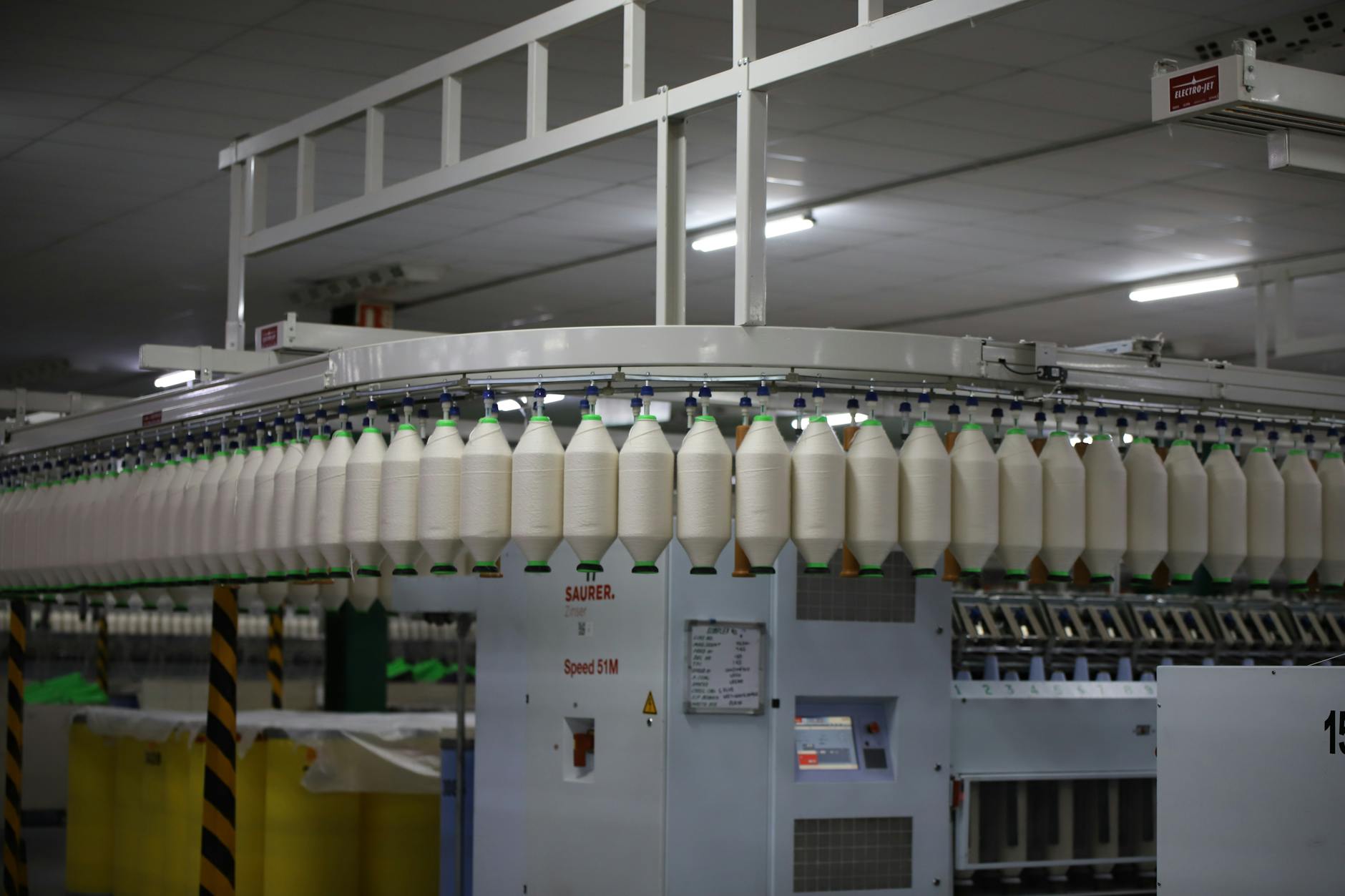
Photo by [Rajesh Kumar Verma](https://www.pexels.com/photo/white-threads-in-factory-8246480/) on Pexels
AI-generated article. Figures and regulatory references link to primary sources.
The textile industry is one of the most carbon-intensive sectors on the planet, and the pressure to change is no longer theoretical. According to the Science Based Targets initiative (SBTi), the apparel and footwear sector is responsible for up to 8% of global emissions, more than aviation and shipping combined. At the same time, regulators are tightening the screws: the EU’s Ecodesign for Sustainable Products Regulation (ESPR), in force since July 2024, designates apparel as a priority sector with compliance deadlines fast approaching. This post lays out a clear textile industry decarbonization roadmap, from understanding where emissions actually hide across the value chain, to the practical levers brands and manufacturers can pull right now to cut carbon at scale.
Key Takeaways
- Textile processing remains the single largest source of sector emissions (around 55%), followed by raw material production (around 22%) per the Apparel Impact Institute’s Low-Carbon Thermal Energy Roadmap, meaning factory energy is where most brands must focus first.
- Devera’s LCA benchmark data for a standard t-shirt shows that manufacturing alone accounts for 60.1% of lifecycle emissions, far outweighing the raw materials phase at 23.5%.
- The sector-wide goal is to reach net zero by 2050, drawing down emissions by 45 percent by 2030, which involves replacing fossil fuels by 2040 with low-carbon thermal energy sources such as industrial heat pumps, electric boilers, and waterless dyeing.
- The ESPR is already in effect, having been adopted in May 2024, with apparel as one of the priority sectors, and by 2027 all apparel products on the EU market must fully comply.
- Measuring product-level carbon footprints via ISO 14040/44-compliant LCA is no longer optional: it is the foundation of every credible decarbonization claim.
Where Do Textile Emissions Actually Come From?
Before building a decarbonization roadmap, you need to understand what you are actually decarbonizing. Many brands assume that shipping and packaging are the dominant villains. The LCA data tells a different story.
Devera’s Monte Carlo LCA benchmark for a single t-shirt, calculated following ISO 14040/44, puts the median carbon footprint at 3.01 kg CO₂e, within a range of 2.12 to 4.12 kg CO₂e. The phase breakdown is striking: manufacturing accounts for 60.1% of lifecycle impact, raw materials for 23.5%, and the use phase (washing and drying by the consumer) for 11.8%. Transport barely registers. If your decarbonization strategy is focused on switching to recycled-content swing tags or optimizing shipping routes, you are addressing perhaps 5% of the problem.
The dyeing and finishing stages are particularly energy-intensive, requiring large amounts of heat and steam, and many textile-producing regions still rely on coal and natural gas for energy, making these processes even more carbon-intensive. That is why the manufacturing phase dominates so heavily in Devera’s benchmark. When you scale this up to industry level, the numbers become staggering: per McKinsey and Global Fashion Agenda’s “Fashion on Climate” 2020 report, the fashion industry was responsible for around 4% of global GHG emissions in 2018, with more than 70% of those emissions coming from upstream manufacturing activities (fibre production, fabric processing, dyeing).
There is another important comparison to make. Devera’s LCA benchmark for a cotton t-shirt shows that raw materials contribute only 23.5% of total impact. This seems low until you remember that polyester tells an even more combustible story. Carbon emissions from synthetics are much higher than cotton because they are made from fossil fuels such as unrefined petroleum products. It is estimated that 5.5 kg CO₂e is emitted to produce one polyester t-shirt, compared to 2.1 kg CO₂e for a cotton t-shirt. Brands that manufacture in polyester-dominant product lines are, in effect, burning petroleum twice: once to make the fibre, and again to process it.
For a deeper look at how to structure lifecycle thinking across your product portfolio, the Life Cycle Assessment: The Complete Guide (2026) provides an excellent methodological foundation.
The Textile Industry Decarbonization Roadmap: Three Core Pillars
A credible textile industry decarbonization roadmap rests on three reinforcing pillars: decarbonizing manufacturing energy, rethinking material sourcing, and embracing circular business models. None of these alone is sufficient.
Pillar 1: Decarbonize the Factory Floor
Thermal energy needs, especially for heating processes, are a significant challenge. Heating often represents over half of the total energy demand in the textile industry, and most of this heat is currently provided by fossil fuels in most countries. This is the single biggest emissions lever available to manufacturers.
The Apparel Impact Institute’s Low-Carbon Thermal Energy Roadmap outlines what it would take to decarbonize a typical wet-processing plant in China, India, Vietnam, Bangladesh, or Indonesia, the five countries that dominate global textile production. This involves replacing fossil fuels by 2040 with low-carbon thermal energy sources such as industrial heat pumps, electric boilers, and waterless dyeing. The technologies exist today. The barrier is financing and regulatory infrastructure, not invention.
In countries like China, India, and Vietnam, where renewable energy supply and regulatory frameworks for corporate procurement are more developed, the report suggests that textile facilities could achieve 100% renewable electricity procurement by 2030. For brands with suppliers in these markets, that is an achievable near-term target, not a distant aspiration.
On renewable electricity, over the last decade there has been almost a 50% reduction in carbon emissions from the electricity used in producing one cotton t-shirt in the UK, while the USA has improved by 25%, Germany by 27%, and China by 16%. This proves that grid decarbonization, when combined with procurement choices, moves the needle measurably at product level.
Pillar 2: Rethink Material Sourcing
Raw materials represent 23.5% of a t-shirt’s carbon footprint in Devera’s benchmark, but that figure can shift dramatically depending on fibre choice and growing or production practices. Cotton’s greenhouse gas emissions per unit are significantly influenced by pesticide and fertilizer use, with fertilizer production being a major contributor in hotspots for cotton LCAs.
Switching to recycled polyester reduces reliance on virgin petroleum feedstock and lowers embedded emissions. Brands should commit to using a higher percentage of sustainable materials, such as recycled polyester and recycled or organic cotton. However, it is important to note that not all “sustainable material” switches deliver the carbon savings brands claim. This is precisely why product-level LCA, rather than generic material declarations, is the only honest way to substantiate material impact claims. You can calculate your product carbon footprint using ISO-compliant methodology to make that case credibly.
The sector will also need to reduce GHG emissions in the supply chain of conventional materials such as cotton. Cotton emissions can be reduced through steps such as input efficiency, using less fertilizer and water, and deploying renewable electricity for cotton ginning and irrigation.
Pillar 3: Circular Business Models
Even a perfectly decarbonized production process does not solve the consumption problem. Global fibre production has almost doubled from 58 million tonnes in 2000 to 116 million tonnes in 2022, and is expected to continue to grow to 147 million tonnes in 2030 if business as usual continues. More garments, made more efficiently, still means more emissions in absolute terms.
The emergence of business models that decouple revenue from selling more new products, such as apparel resale and rental, can help address unchecked consumption. These are not niche experiments anymore. Resale platforms, repair services, and rental subscriptions are becoming commercially viable at scale, and brands that build them into their operating model now will be better positioned to meet 2030 targets.
End-of-life is the other circular gap. Less than half of used garments are collected for reuse or recycling, and only 1% of used clothes are recycled into new clothes, since technologies that would enable clothes to be recycled into virgin fibres are only now starting to emerge. This explains why Devera’s t-shirt benchmark shows the use phase contributing 11.8% to lifetime impact: consumer washing and drying behaviour adds materially to a garment’s total footprint, and an end-of-life scenario that ends in landfill or incineration adds a final insult.
The principles of circular product design offer practical tools for embedding end-of-life thinking into garment development from the very first sketch.
The Regulatory Clock Is Ticking
No textile industry decarbonization roadmap in 2026 can ignore the regulatory backdrop. The European Union has taken the most aggressive lead in establishing new standards and reporting requirements, and the ESPR, which entered into force on 18 July 2024, mandates comprehensive ecodesign requirements for various product groups, including textiles and apparel.
The practical implications unfold in stages. The EU Strategy for Sustainable and Circular Textiles includes increasing the longevity of textiles, increasing the use of recycled fibers, curbing fast fashion, and making products easier to repair or recycle with a Digital Product Passport. The textiles and apparel delegated act is expected to be adopted around 2027, leading to compliance deadlines around mid-2028.
Beyond ecodesign, the destruction of unsold stock is now explicitly banned. This is the most aggressive aspect of the regulation for the fashion industry, addressing the scandal of burning deadstock, and it is effective from 19 July 2026. Brands that have relied on overproduction as a hedge need to rethink their inventory strategies immediately.
According to the European Environment Agency, the supply chain supporting EU textile consumption generated 159 million tonnes of CO₂e in 2022, or about 355 kg per person, with around 70% of those emissions released outside Europe (mostly in Asia where production is concentrated). That figure is a benchmark the industry needs to bring down substantially.
For brands navigating the full sweep of green claims compliance, the EU Green Claims Directive Explained provides a clear breakdown of what substantiation now requires.
From Roadmap to Action: Measuring What Matters
As of 2025, hundreds of apparel, footwear, and textiles companies have approved science-based targets or commitments to set them via the SBTi target dashboard, illustrating the sector’s leadership among all sectors in addressing climate change. But targets without measurement are aspirations, not plans.
The gap between a brand’s ambition and its supply chain reality is almost always a data problem. Life cycle assessment evaluates the environmental impact of a product from raw material extraction to its final disposal. In the garment industry, this approach helps identify critical points in the supply chain where emissions are highest, allowing companies to develop targeted reduction strategies.
What LCA reveals, time and again, is that the intuitive assumption about where emissions come from is wrong. Devera’s benchmark data for a t-shirt shows that if a brand achieves an A-grade carbon performance (below 2.41 kg CO₂e per garment), it has done so primarily by attacking manufacturing energy, not by switching to organic cotton labels. That is a strategic insight that only rigorous, ISO 14040/44-aligned LCA can surface. Without it, brands risk investing in the wrong interventions and, worse, making sustainability claims they cannot substantiate.
The sustainable fashion guide for 2026 expands on how measurement connects to credible claims and consumer trust.
Frequently Asked Questions
What is a textile industry decarbonization roadmap? A textile industry decarbonization roadmap is a structured plan that identifies the emission hotspots across a brand or manufacturer’s value chain and sets out time-bound interventions to reduce them. It typically covers manufacturing energy, material sourcing, logistics, consumer use, and end-of-life disposal, aligned with science-based targets such as a 45% reduction by 2030 and net zero by 2050.
How does LCA help with textile decarbonization? Life cycle assessment (LCA) quantifies greenhouse gas emissions at every stage of a product’s life, from fibre cultivation or polymer production through manufacturing, transport, consumer use, and disposal. For textiles, LCA consistently reveals that manufacturing energy is the dominant impact phase, which focuses investment decisions on factory-level interventions rather than superficial changes like packaging.
Which phase of a garment’s life generates the most carbon emissions? For most garments, the manufacturing phase, particularly dyeing, finishing, and other wet-processing steps, generates the largest share of lifetime carbon emissions. Devera’s ISO 14040/44 benchmark data for a standard t-shirt shows manufacturing contributing 60.1% of total footprint, with raw materials adding 23.5% and consumer use phase (washing and drying) a further 11.8%.
When do textile brands need to comply with EU decarbonization regulations? The ESPR entered into force in July 2024, making apparel one of its priority sectors. The ban on destruction of unsold textiles takes effect for large enterprises from July 2026. The textiles delegated act setting detailed ecodesign performance requirements is expected around 2027, with compliance deadlines following approximately 18 months later in mid-2028. Digital Product Passports for garments are expected to be mandatory by 2027.
If your brand is ready to move from roadmap to numbers, Devera’s AI-powered LCA platform can calculate your product carbon footprint following ISO 14040/44 in a fraction of the time traditional methods require. Explore how it works or see our pricing to find the plan that fits your portfolio.