
Sustainable Manufacturing: A Complete 2026 Guide
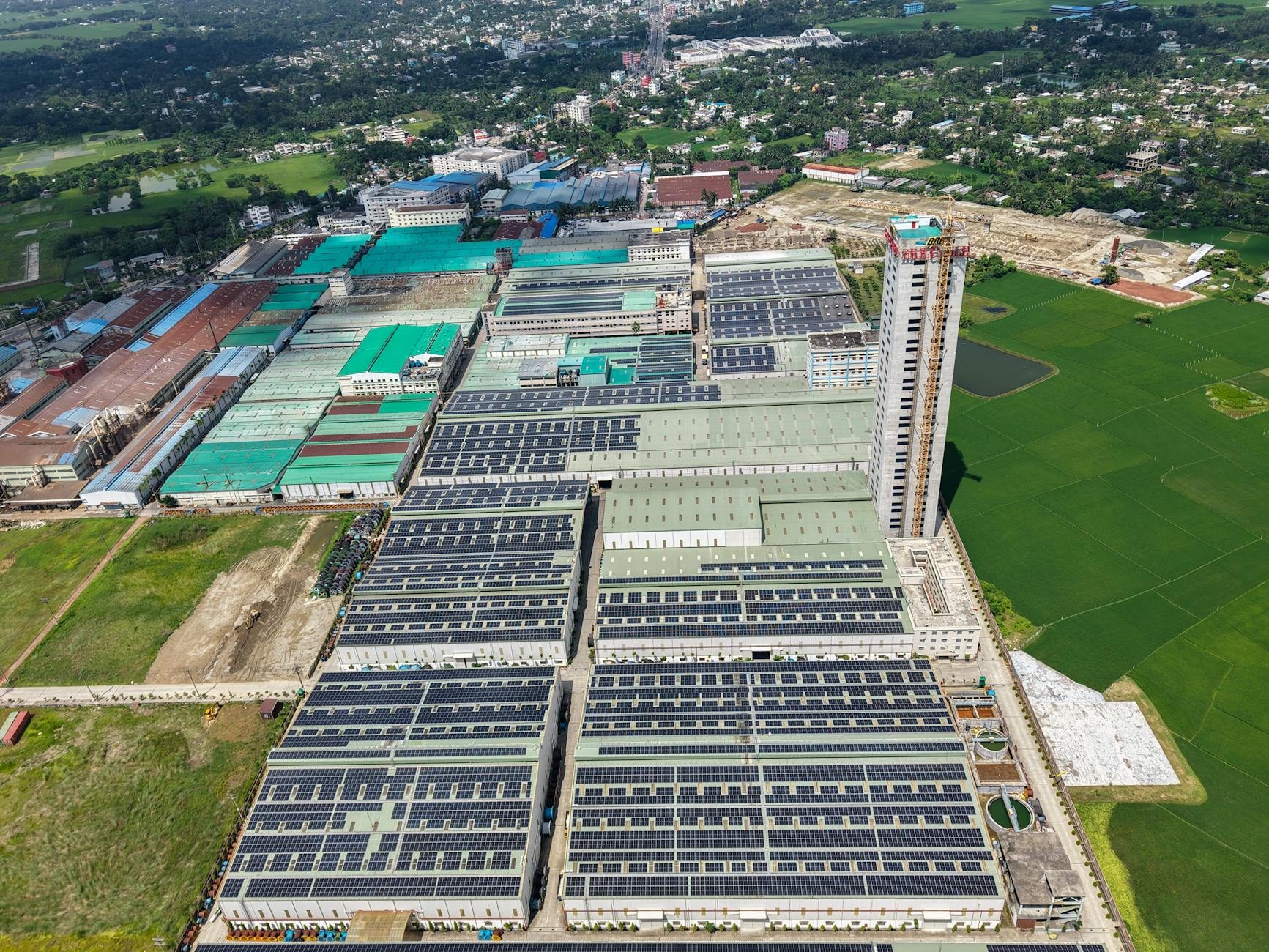
Photo by [Sarowar Hussain](https://www.pexels.com/photo/aerial-view-of-large-industrial-complex-with-solar-panels-33626641/) on Pexels
AI-generated article. Figures and regulatory references link to primary sources.
Key Takeaways
- Sustainable manufacturing is not just about swapping materials, it requires knowing exactly which phase of a product’s life cycle drives the most emissions.
- Different product categories tell dramatically different stories: manufacturing dominates for textiles, raw materials for safety equipment and body care, and the use phase for electronics.
- Regulatory pressure is intensifying, with the EU’s Corporate Sustainability Reporting Directive (CSRD) and the Empowering Consumers for the Green Transition Directive (ECGT), applicable from September 2026, making product-level carbon data a legal expectation, not a marketing bonus.
- Life Cycle Assessment (LCA) following ISO 14040/44 is the gold-standard method for identifying where to intervene in a production process.
- Brands that measure first and act second consistently outperform those chasing vague sustainability targets.
Sustainable manufacturing has graduated from a corporate talking point to an operational imperative. In 2026, companies across every sector, from apparel to electronics to fast-moving consumer goods, face mounting pressure from regulators, investors, and consumers to demonstrate, with evidence, that their production processes are genuinely less harmful to the planet. But “sustainable” is a notoriously slippery word. What it actually means in a factory context, and how you measure progress toward it, depends entirely on understanding where emissions truly originate across a product’s full life cycle.
That is where rigorous LCA methodology changes the conversation. Rather than guessing which process to green-wash or which supplier to blame, a well-executed LCA maps every kilogram of CO₂-equivalent back to a specific phase, raw material extraction, manufacturing, transport, use, or end of life. The results routinely defy intuition, and that is precisely why they matter.
What Does Sustainable Manufacturing Actually Mean?
At its core, sustainable manufacturing is the practice of creating products in ways that minimise environmental impact, conserve resources, and are economically viable over the long term. The U.S. Department of Energy has long framed it around energy efficiency and waste reduction, but modern definitions have expanded considerably. Today the concept encompasses greenhouse gas emissions across the entire supply chain, water consumption, biodiversity impact, and circular end-of-life strategies.
The challenge is that most companies still think of “manufacturing” as what happens on the factory floor. A full life cycle perspective reveals a more complicated picture. For an LCA practitioner, manufacturing is just one of several phases, and in many product categories it is not even the biggest emitter.
For a deeper grounding in the methodology underpinning this kind of analysis, the Life Cycle Assessment: The Complete Guide (2026) walks through everything from system boundary definition to impact category selection.
The Lifecycle Phases That Actually Drive Emissions
When Manufacturing Is the Villain, and When It Isn’t
Consider the humble t-shirt. According to Devera’s Monte Carlo LCA benchmark (ISO 14040/44), a single t-shirt has a median carbon footprint of 3.01 kg CO₂e, ranging from 2.12 to 4.12 kg CO₂e. What is striking is the phase breakdown: manufacturing accounts for 60.1% of total emissions, with raw materials contributing just 23.5% and the use phase (washing, drying) adding 11.8%. For a textile brand, this data tells you where the battle is won or lost. Optimising spinning, dyeing, and finishing processes is not just operationally sensible, it is where the carbon lever sits. Switching to organic cotton, while beneficial, addresses less than a quarter of the footprint.
Now compare that to a safety equipment container. Devera’s benchmark places the median footprint at 4.47 kg CO₂e per kilogram, with raw materials responsible for 57.5% of total emissions and manufacturing contributing 35.9%. Here the script flips. If a manufacturer in the safety sector focuses exclusively on energy efficiency in their production facility, they are optimising a 35.9% slice while ignoring the 57.5% that already arrived at their gates in the form of virgin polymer or steel. Switching to recycled or bio-based feedstocks would have nearly twice the impact of any factory-floor intervention.
Electronics: The Use Phase Surprise
Laptops add another wrinkle to the story. Devera’s benchmark puts the median laptop footprint at 215.10 kg CO₂e, ranging from 157.88 to 286.70 kg CO₂e, orders of magnitude larger than the consumer goods above. What makes laptops genuinely unusual is that the use phase (38.3%) slightly edges out raw materials (36.5%), with manufacturing accounting for just 24.7%. This means a laptop manufacturer pursuing sustainable manufacturing through greener assembly processes is, again, addressing the smallest of the three major contributors. The bigger wins come from designing more energy-efficient chips and screens (cutting use-phase emissions) and from sourcing conflict-free, low-carbon minerals (cutting raw material emissions). It is also a compelling argument for product longevity: the longer a laptop stays in use, the more its embodied carbon gets amortised across years of service.
Packaging and Formulation: Lessons from Consumer Goods
Body cream offers perhaps the most counter-intuitive lesson of all. With a median footprint of 2.50 kg CO₂e per container, raw materials represent 47.7% of total emissions, nearly double the 24.1% attributed to manufacturing, and almost three times the 17.1% from packaging. Many brands in the beauty and personal care space spend significant energy on packaging redesign, switching to recycled PET, reducing wall thickness, eliminating secondary packaging. These are worthwhile steps, but they target a 17.1% slice. The ingredient supply chain, by contrast, is the dominant hotspot, and it is often the last place brands think to look.
This kind of insight is what separates product sustainability strategy built on data from strategy built on assumption.
The Regulatory Landscape Shaping Sustainable Manufacturing in 2026
Manufacturers cannot afford to treat sustainability as voluntary for much longer. Several regulatory developments have fundamentally altered the landscape.
The EU Corporate Sustainability Reporting Directive (CSRD) now requires large companies, and increasingly SMEs in their supply chains, to disclose detailed environmental data, including product-level Scope 3 emissions. Scope 3 is where lifecycle thinking becomes non-negotiable: it captures upstream raw material emissions and downstream use-phase emissions, the very hotspots that factory-only thinking misses.
The original EU Green Claims Directive proposal, which would have required third-party verification of all voluntary environmental claims, was withdrawn by the European Commission in June 2025 amid concerns about administrative burden. But the Empowering Consumers for the Green Transition Directive (ECGT) is already law, banning generic environmental claims and offset-based “carbon neutral” product labels from September 2026. In practice, this means vague claims like “eco-friendly production” or “low-carbon manufacturing” must be substantiated with recognised scientific evidence, and for product carbon footprints, that means ISO 14040/44-compliant LCA.
Beyond the EU, the Science Based Targets initiative (SBTi) has been pushing manufacturers to align their reduction roadmaps with a 1.5°C trajectory, requiring granular product-level data as the foundation for credible target-setting.
| Regulation / Framework | Scope | Key Requirement for Manufacturers |
|---|---|---|
| EU CSRD | Large EU companies + supply chains | Product-level Scope 3 disclosure |
| EU ECGT (active since Sep 2026) | B2C environmental claims in EU market | LCA-backed substantiation of claims |
| ISO 14040/44 | Global standard | Full lifecycle methodology for LCA |
| SBTi FLAG / Industry | Sector-specific | Science-based reduction targets by category |
Where to Intervene: Turning LCA Data into Strategy
Understanding the lifecycle hotspot for your specific product category is step one. Step two is knowing what kinds of interventions move the needle in each phase.
For manufacturing-dominated products like apparel, the priority list typically includes transitioning to renewable energy in production facilities, replacing synthetic dyes with low-impact alternatives, and improving process water efficiency. The 60.1% manufacturing share in a t-shirt’s footprint means that even a 20% reduction in production-phase emissions cuts the total footprint by more than 12 percentage points, a meaningful gain.
For raw-material-dominated products, body cream, safety equipment, packaging-heavy goods, the intervention logic shifts upstream. Supplier engagement, ingredient-level LCAs, and procurement criteria based on environmental performance become the primary tools. This is uncomfortable territory for many procurement teams, but it is where the data points.
For use-phase-dominated products like laptops, sustainable manufacturing strategy necessarily extends beyond the factory to product design. Energy labelling, user behaviour nudges (default power-save settings, automatic sleep modes), and extended producer responsibility schemes all play a role.
The key insight across all categories is that calculating your product carbon footprint is not the end of the process, it is the beginning of a targeted reduction strategy.
From Measurement to Meaningful Action
There is a meaningful difference between brands that measure and brands that act on what they measure. According to research on brands that measure, companies that publish product-level environmental data consistently build stronger consumer trust and are better positioned to survive regulatory scrutiny.
The wine industry illustrates this well. Devera’s benchmark for a 750ml bottle of wine places the median footprint at 1.89 kg CO₂e, with raw materials responsible for 52.4% of that total and manufacturing for 38.9%. For a wine producer, “sustainable manufacturing” might conjure images of solar panels on the winery roof, and those are genuinely worth pursuing. But the 52.4% raw material share points to viticulture practices: soil management, fertiliser use, water consumption in the vineyard. A winery that only measures energy at the bottling line is missing more than half the story.
This is the broader lesson that sustainable manufacturing in 2026 demands. The factory is part of the system, not the whole of it. Getting the full picture requires methodological rigour, product-specific data, and a willingness to act on findings even when they implicate parts of the business that are harder to control.
Frequently Asked Questions
What is sustainable manufacturing and how does it differ from traditional manufacturing? Sustainable manufacturing refers to the production of goods using processes that minimise environmental impact, reduce energy and resource consumption, and avoid creating pollution or waste that future generations will need to manage. Unlike traditional manufacturing, which tends to optimise for cost and throughput alone, sustainable manufacturing uses environmental metrics, including carbon footprint, water use, and material efficiency, as key performance indicators alongside financial ones.
How do you measure the carbon footprint of a manufacturing process? The most rigorous approach is a Life Cycle Assessment conducted in accordance with ISO 14040 and ISO 14044, which maps emissions across every stage from raw material extraction through to end of life. This requires primary data on energy use, material inputs, and logistics, combined with background databases for upstream supply chain emissions. The result is a product carbon footprint expressed in kilograms of CO₂-equivalent (kg CO₂e), which can then be benchmarked against industry peers to identify reduction priorities.
Which phase of the life cycle typically contributes most to manufacturing emissions? It depends heavily on the product category. For textiles, manufacturing itself is the dominant phase. For raw-material-intensive products like safety equipment or personal care goods, the extraction and processing of input materials often outweighs factory emissions significantly. For electronics, the use phase can rival or exceed both. This is precisely why a product-specific LCA is more actionable than sector-level generalisations.
What regulations require manufacturers to measure and report product-level emissions? The EU’s Corporate Sustainability Reporting Directive (CSRD) already mandates disclosure of Scope 3 emissions for large companies, which includes product lifecycle impacts. The Empowering Consumers for the Green Transition Directive (ECGT, Directive 2024/825), applicable from September 2026, bans generic environmental claims and offset-based “carbon neutral” product labels unless substantiated with recognised scientific evidence, which in practice means an ISO 14040/44-compliant LCA. The original Green Claims Directive proposal was withdrawn by the Commission in June 2025. Beyond Europe, frameworks like the Science Based Targets initiative (SBTi) encourage, and in some sectors require, product-level carbon data as the foundation for credible net-zero commitments.
Start Measuring Before You Optimise
The brands making the most genuine progress on sustainable manufacturing share one habit: they know their numbers. Not approximate numbers, not industry averages borrowed from a trade report, their own product-level carbon footprint data, broken down by lifecycle phase, calculated to a defensible scientific standard.
If you are ready to move from assumption to evidence, Devera offers AI-powered, ISO 14040/44-compliant LCA calculations that tell you exactly where your product’s emissions come from, and where reducing them will have the greatest effect. Because sustainable manufacturing, done properly, starts with knowing what you are actually dealing with.